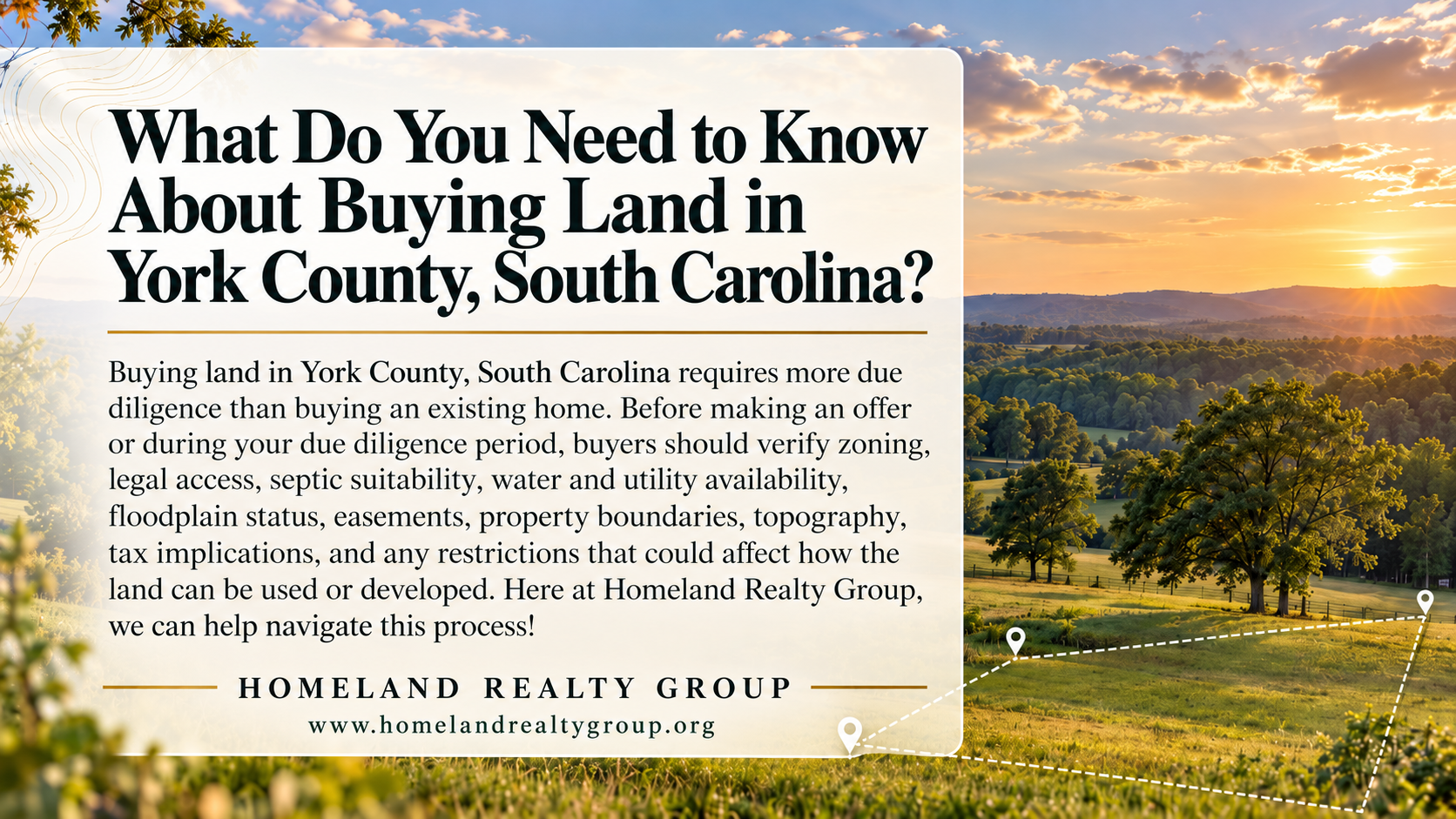
Buying land can be exciting. Whether you are looking for a homesite, acreage, a small farm, investment property, recreational land, or a place for a manufactured home, York County, South Carolina offers a wide variety of options.
But buying land is very different from buying an existing home. Thats why it is important to hire a local expert to help you navigate the process! Here at Homeland Realty Group we can help!
A beautiful piece of property may look perfect from the road while having restrictions, access issues, septic limitations, floodplain concerns, or zoning requirements that affect what you can actually do with it.
Before making an offer on land in York County, here are 12 important things to investigate.
1. What Is the Property Zoned?
Start with zoning—but don't stop there.
A property's zoning classification determines many of the uses that may be permitted. If your plans include building a home, placing a manufactured home, operating a business, keeping certain animals, developing multiple homesites, or creating another specialized use, verify that your intended use is allowed.
Also, determine which jurisdiction controls the property. Property inside a municipality may be subject to different regulations than property in unincorporated York County. I highly recommend this be in writing from a county official. Not just verbally over the phone.
2. Does the Zoning Actually Allow What You Want to Do?
"Residential" does not automatically mean you can do anything residential.
For example, York County's zoning regulations distinguish among different residential uses, densities, manufactured housing, subdivisions and other uses.
Tell your real estate agent exactly what you intend to do with the property before making an offer.
A good question isn't simply:
"Can I build here?"
It is:
"Can I build what I want to build here?"
3. Does the Property Have Legal Access?
Never assume that because you can physically drive to a property, you have adequate legal access.
Look for:
- Public road frontage
- Recorded access easements
- Shared or private roads
- Road-maintenance agreements
- Rights-of-way
York County's Land Development Code contains specific access and easement requirements for certain types of land divisions, including provisions for private access easements.
Access can also affect financing and future resale.
Tell me... feeling lost? Keep reading, but remember! WE can help!
4. Will the Property Support a Septic System? Does it have public sewer?
This can be one of the most important questions when buying rural land.
If public sewer isn't available, South Carolina requires approval and permitting for an onsite septic system. The South Carolina Department of Environmental Services advises buyers to investigate septic suitability before purchasing land.
A failed septic evaluation doesn't necessarily make property worthless, but it can dramatically change construction plans and costs. For real, y'all. This is a biggie.
5. Where Will Your Water Come From?
Determine whether the property has access to:
- Public water
- Community water
- An existing private well
- A location suitable for a new well
Don't confuse a water line being "nearby" with having an available connection. Verify availability and potential tap or extension costs.
6. Is Any of the Property in a Floodplain?
York County's One Map allows property owners and buyers to view FEMA floodplain information associated with a parcel.
Floodplain does not automatically mean the property cannot be used, but it can affect:
- Where you build
- Construction requirements
- Insurance
- Financing
- Septic placement
- Future resale
Also look at creeks, drainage areas and low-lying portions of the property.
7. Are the GIS Property Lines Accurate?
This is a big one. Sometimes, they are not!
York County specifically states that the digital property boundaries shown on One Map are approximations of the legal documents and recommends checking the officially recorded plat or legal description.
In other words, don't assume the line you see on your phone is exactly where the property line is located.
For important boundary questions, a survey is the better tool.
8. Are There Easements or Restrictions?
A property may be subject to restrictions that aren't obvious when standing on the land.
Review available deeds, plats and title information for:
- Utility easements
- Access easements
- Pipeline easements
- Private restrictions
- Subdivision covenants
- Rights-of-way
Something that does not show prominently on a real estate listing can still significantly affect your intended use.
9. What Utilities Are Actually Available?
Check availability and cost for:
- Electricity
- Water
- Sewer
- Natural gas
- Internet
- Cable/fiber
For rural acreage, bringing power or other utilities a long distance into the property can become a substantial expense.
10. What Is the Topography Like?
Ten acres on paper does not always mean ten easily usable acres.
Look at:
- Steep slopes
- Creek bottoms
- Drainage
- Rock
- Heavy timber
- Wet areas
- Suitable building locations
- Cost of driveway construction
The cheapest land isn't always the least expensive land to develop.
11. Is the Property Currently Receiving an Agricultural Tax Classification?
If land is currently taxed based on agricultural use, investigate what happens if you change that use.
York County explains that changing qualifying agricultural property to another use can result in rollback taxes, including situations involving construction, manufactured homes or subdivision of agricultural land. Current county guidance indicates rollback calculations may include the year of the change plus the three preceding tax years.
This should be investigated while writing the offer!!! not after receiving an unexpected tax bill. Any of the agents here at Homeland Realty Group can help!
12. Will the Property Work for You—and the Next Buyer?
Finally, think beyond today's purchase.
Road access, zoning, septic approval, utilities, topography, restrictions and location don't just affect what you can do with the land. They also affect its future marketability and value.
A property can be beautiful and still be difficult to finance, develop or eventually resell.
Before You Make an Offer on York County Land
Land purchases deserve careful due diligence.
At Homeland Realty Group, we work with buyers and sellers throughout York County and the surrounding area, helping them navigate the buying and/or selling process of rural property, acreage, manufactured homes with land, recreational property and development opportunities.
If you have found a property you're considering, reach out to us for help!
We can help you identify the questions that need to be answered regarding zoning, access, comparable sales, utilities, property records and potential resale value—and help you structure an offer that gives you the opportunity to complete the appropriate due diligence.
You know, protect you. That's what we are here for! Looking forward to hearing from you soon!
Danielle Childers, Broker-in-Charge
Homeland Realty Group, LLC
This article is intended for general real estate information and is not legal, engineering, surveying, environmental, zoning or tax advice. Property-specific questions should be verified with the appropriate professionals and governmental agencies.